
Power outages used to be something businesses just planned around, a generator in the back lot, a few hours of lost productivity, and a return to normal once the grid came back. That tolerance for downtime has mostly disappeared.
Data centers, hospitals, factories, and telecom networks now operate on the assumption that power simply doesn’t go out, and energy storage is the technology quietly making that assumption possible.
This guide answers the question directly: how does energy storage improve reliability, what actually happens inside a system during a disruption, and what to look for if your business is evaluating a system or a sourcing partner to help build one.
Whats Reliability Actually Means for a Power System
Before getting into how storage helps, it’s worth being specific about what reliability means in this context, because it covers more than just the lights stay on.
A reliable power system needs to do three things consistently, maintain stable voltage and frequency, respond fast enough to sudden changes in demand, and keep operating through unplanned disruptions.
Traditional power generation, coal, gas, even nuclear, is good at steady, predictable output but slow to react to sudden spikes or drops. That mismatch between slow-responding generation and fast-changing demand is exactly where reliability problems start.
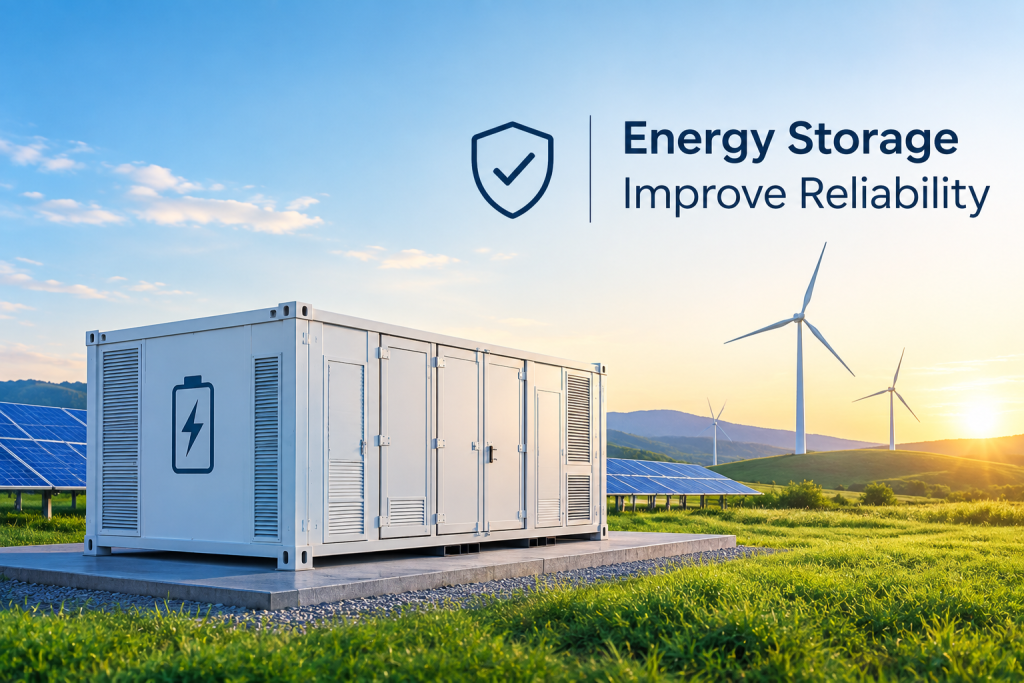
How Does Energy Storage Improve Reliability?
This is the core question, and it breaks down into four distinct mechanisms, each solving a different kind of reliability problem.
1. Instant Response to Demand Spikes
Power grids are sized for average demand, not peak demand. When usage suddenly jumps, a heat wave pushing every air conditioner to run at once, or a factory floor ramping up production, traditional power plants take time to increase output. Energy storage systems don’t have that delay. A battery can discharge stored power within milliseconds, covering the gap until slower generation sources catch up. This is often called peak shaving, and it prevents the kind of demand spike that would otherwise strain the grid or trigger a brownout.
2. Backup Power During Outages
This is the most intuitive way energy storage improves reliability, and also the most critical for certain industries. When the grid goes down, a stored charge keeps critical systems running, sometimes for a few minutes until backup generators start, sometimes for hours if the system is sized for it. For a hospital, a data center, or a telecom base station, that bridge period isn’t a convenience; it’s the difference between continuous operation and a serious failure.
3. Voltage and Frequency Stabilization
Electrical grids need to stay within a narrow band of voltage and frequency to function correctly. Equipment that’s sensitive to fluctuations, medical devices, precision manufacturing tools, data center servers, can be damaged or forced into shutdown by even small deviations. Energy storage systems can inject or absorb power in fractions of a second, smoothing out fluctuations before they cascade into a larger problem. Traditional power plants, with their slower mechanical response times, simply can’t correct these issues as quickly.
4. Reducing Dependence on a Single Point of Failure
A power system that relies entirely on one source, one grid connection, one generator, has an obvious weak point. Energy storage adds redundancy. If the primary source fails, the system can draw on stored energy while a secondary source comes online, rather than experiencing a hard stop. This layered approach is a big part of why utilities and large facilities increasingly treat storage as core infrastructure rather than a backup afterthought.
Why this Matters More With Renewable Energy
Reliability concerns become sharper once solar and wind enter the picture, because both are inherently inconsistent. Solar panels stop producing at night; wind turbines slow down when the wind does. Without storage, a renewable-heavy grid would have real gaps in supply. With it, the stored energy from a sunny afternoon or a windy night can be released exactly when it’s needed, turning an intermittent source into something closer to a reliable one.
This is a major reason battery energy storage systems (BESS) have moved from a niche technology to a standard part of renewable energy projects, reliability isn’t a side benefit, it’s often the deciding factor in whether a renewable installation is viable at all.
What this Looks Like in Practice
Consider a manufacturing facility running continuous production. A momentary outage or voltage dip can shut down a line, waste materials mid-process, and cost hours in restart time. An on-site energy storage system smooths out short-term fluctuations automatically and provides bridging power during longer outages, without needing a human to intervene or a generator to spin up. The reliability improvement isn’t theoretical here, it shows up directly in fewer stopped production runs and less scrapped material.
The same logic applies at a much larger scale for a telecom operator maintaining base stations across a wide coverage area, or a utility trying to keep frequency stable across a regional grid. The mechanism is identical; only the scale changes.
What to Look for in an Energy Storage Solutions Provider
Understanding how storage improves reliability is one thing. Actually sourcing a system that delivers on that promise is another, and it depends heavily on the provider behind it.
A capable energy storage solutions provider should offer more than a product catalog. Look for:
● OEM ODM energy storage capability. This means a provider can either source an existing, proven design (OEM) or work with a manufacturer to build a fully custom system (ODM) when standard configurations don’t fit the project’s voltage, capacity, or space requirements.
● A genuine supplier network, not a single factory relationship. Being tied to one manufacturer limits flexibility on price, lead time, and technical specification.
● Quality verification before shipment. Battery cells and battery management systems are difficult to inspect after installation, so catching issues at the factory stage matters more than most buyers realize.
● Project management from spec to delivery, so sourcing, customization, and logistics are handled as one coordinated process rather than several disconnected vendor relationships.
For larger or more complex projects, working with an energy storage system integrator specifically, a partner experienced in matching cell-level components to full system-level requirements, tends to produce a more reliable outcome than sourcing components piecemeal and integrating them independently.
Frequently Asked Questions
Does energy storage completely eliminate the risk of outages?
No system eliminates risk entirely, but a properly sized energy storage system dramatically reduces both the frequency and impact of disruptions, particularly short-term ones that make up the majority of power quality issues.
Is battery storage the only technology used for reliability?
No. Flywheels, pumped hydro, and thermal storage all play a role in different contexts, but battery-based systems dominate commercial and industrial reliability applications due to their fast response time and scalability.
How do I know what size system my business needs?
This depends on load profile, the length of outages you need to cover, and your budget for redundancy. An experienced energy storage solutions provider can assess these factors and recommend a system sized appropriately, rather than defaulting to a one-size-fits-all configuration.
Bottom Line Conclusion
How does energy storage improve reliability? By responding to demand changes instantly, providing backup during outages, stabilizing voltage and frequency, and reducing dependence on any single power source. Together, these mechanisms are why energy storage has shifted from a specialty technology to a standard expectation across industries that can’t tolerate downtime.
Getting the reliability benefit in practice depends on sourcing the right system from the right partner, one capable of OEM ODM energy storage solutions, backed by a real supplier network and genuine quality control, rather than just selling whatever’s easiest to source.
Yostar Tech works as an energy storage solutions provider and system integrator, sourcing battery cells, BMS units, and full energy storage assemblies through a vetted manufacturer network, with the OEM and ODM flexibility to match a project’s exact requirements. If your business needs a sourcing partner who understands what actually goes into a reliable energy storage system, reach out to Yostar Tech to talk through your requirements.