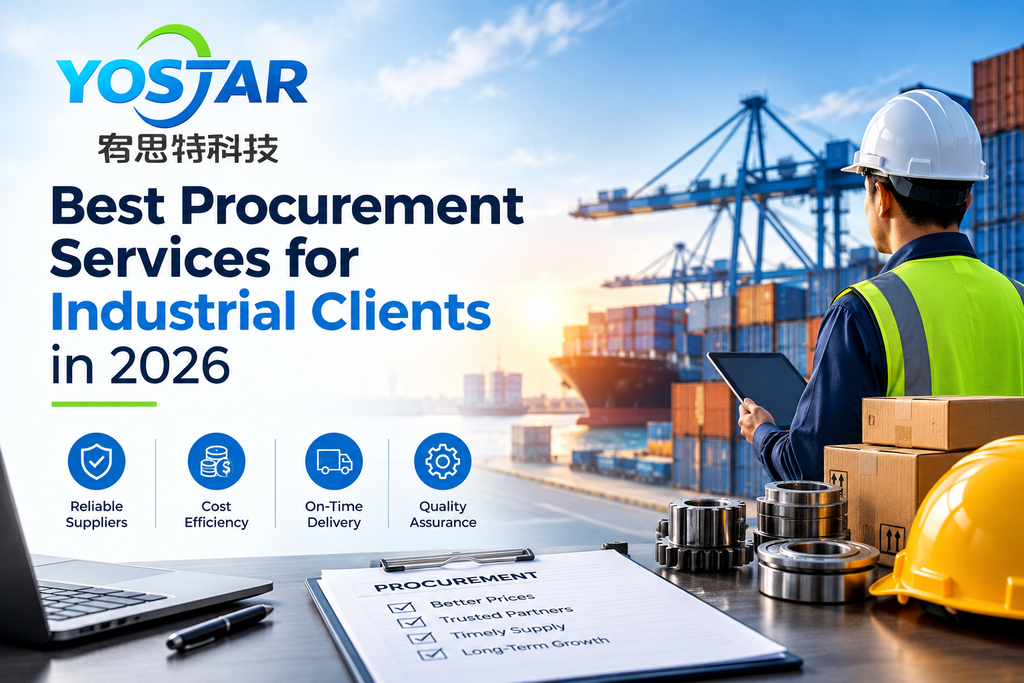
The short answer is that, if you’re evaluating the best services to procure for your industrial operation by 2026, then look for a provider who offers integrated procurement service, MRO, industrial sourcing, and supply-chain execution from end-to-end, and not just software or labor staffing. This guide explains the different types of procurement, evaluates criteria and gives real-world examples that industrial buyers should consider before signing contracts.
Industrial procurement in 2026 looks very different from even five years ago. Tariff volatility, longer lead times on specialized components, and pressure to consolidate vendors have pushed manufacturing, energy, construction, and infrastructure companies to rethink how they source. Some are leaning on large consulting-style outsourcers. Others are building hybrid models. A growing number are turning to specialized global sourcing partners who can find, vet, and deliver physical industrial products, not just manage paperwork or staffing.
Why Industrial Procurement Strategy Matters More in 2026
Three forces are reshaping industrial buying decisions this year:
- Tariff and trade volatility. Shifting trade policy across major manufacturing corridors is forcing companies to diversify supplier bases and re-evaluate landed cost, not just unit price.
- Lead times that are unpredictable and extended. Supplier relationships, sourcing agility, and allocation constraints are still a competitive edge for specialized components, semiconductors. precision-machined pieces, industrial electronics.
- Vendor consolidation pressure. Finance teams increasingly want fewer, more capable suppliers managing broader scopes, which is driving demand for integrated procurement services that bundle sourcing, logistics, and supplier management under one contract.
Together, these trends mean the best procurement partner in 2026 isn’t necessarily the biggest name, is the one that can move fast, source globally, and absorb complexity on your behalf.
Types of Procurement Services Industrial Clients Need
Not every industrial buyer needs the same procurement model. Here’s how the major categories break down.
1. MRO Procurement Services
MRO procurement covers the recurring purchase of maintenance parts, spare components, tools, and consumables that keep plants and facilities operational. Because MRO spend is often fragmented across hundreds of small suppliers, this category benefits the most from centralized sourcing and category management, consolidating vendors typically cuts both unit cost and administrative overhead.
2. Project-Based Procurement Services
Project-based procurement supports a defined scope, a plant expansion, a new production line, a facility retrofit. This model, unlike ongoing MRO spending, is milestone-driven. It places a heavy emphasis on managing lead times, supplier qualification and logistics coordination in order to avoid costly delays.
3. Commercial Procurement Services
Commercial procurement services are designed to meet the needs of businesses beyond office supplies, general operating goods, and production equipment. Standardizing commercial procurement across multiple locations can reduce maverick spending and increase negotiating power for industrial clients with multiple sites.
4. Commercial Energy Procurement Services
Energy-intensive industrial operations increasingly use dedicated commercial energy procurement services to manage utility contracts, equipment tied to energy infrastructure, and sourcing for renewable or backup power components. With energy costs remaining a top line-item concern, this has become its own specialized procurement category rather than an afterthought.
5. Integrated (End-to-End) Procurement Services
Integrated procurement services combine sourcing, supplier management, logistics, and compliance into a single managed workflow, often called end-to-end procurement services. This is the model most large industrial buyers are moving toward in 2026, because it removes the friction of coordinating multiple vendors for what is functionally one supply chain.
| Procurement Type | Best For | Key Benefit |
| MRO Procurement | Ongoing plant/facility maintenance | Lower unit cost, fewer stockouts |
| Project-Based Procurement | Capital projects, expansions, retrofits | On-time delivery, milestone control |
| Commercial Procurement | Multi-site operational purchasing | Standardization, reduced maverick spend |
| Commercial Energy Procurement | Energy-intensive operations | Contract optimization, supply security |
| Integrated / End-to-End Procurement | Enterprises consolidating vendors | Single point of accountability |
How to Choose the Best Procurement Services Partner
When evaluating providers, industrial buyers should score candidates against these criteria:
- Industrial sourcing depth: Can they actually source specialized industrial components and equipment, or only manage service contracts and software?
- Global supplier network: Do they offer genuine global procurement services with vetted manufacturers across multiple regions, or a limited domestic panel?
- Supply-chain execution: Do they handle logistics, customs, and delivery, or hand that off entirely to you after sourcing?
- Transparent pricing: Is cost structure clear, or bundled into opaque managed-service retainers?
- Responsiveness: Smaller, specialized partners often outperform large “multi-tower” firms on speed and account intimacy, particularly for urgent or project-based sourcing needs.
- Risk and compliance management: Can they vet suppliers for quality, financial stability, and regulatory compliance before you’re locked into a contract?
Consolidating a Fragmented MRO Supply Chain
A mid-sized industrial manufacturer running three plants across two countries was managing MRO purchasing through 40+ individual suppliers, with no centralized visibility into spend or lead times. After moving to an integrated procurement services model, consolidating vendors, standardizing part specifications, and centralizing supplier vetting, the company reduced its active supplier count by roughly 60%, shortened average part lead time, and gained a single point of accountability for quality issues. This is the type of outcome strategic procurement services are designed to deliver: not just lower prices, but structural efficiency across the supply chain.
Where YoStar Tech Fits In
Most large procurement outsourcers are built around managing services and labor consultants, contractors, staffing. That leaves a real gap for industrial clients who need someone to actually find, source, qualify, and deliver physical industrial products and components.
YoStar Tech operates as a global industrial procurement, sourcing, and supply-chain partner, not an online parts retailer. That distinction matters: instead of browsing a limited catalog, industrial clients work with a sourcing team that identifies qualified manufacturers worldwide, negotiates on their behalf, manages quality and compliance checks, and coordinates logistics through to delivery.
This covers MRO procurement, project-based sourcing for capital initiatives, commercial and commercial energy procurement, and fully integrated, end-to-end procurement programs, built around the buyer’s supply chain, not a fixed product list.
Pros and Cons of Outsourcing Industrial Procurement
| Pros | Cons |
| Access to broader, often global supplier networks | Requires clear scope definition to avoid scope creep |
| Frees internal teams to focus on core operations | Some loss of direct day-to-day supplier contact |
| Better cost visibility through consolidated spend data | Onboarding takes time to align on specs and standards |
| Faster response to urgent or project-based sourcing needs | Vendor selection still requires internal due diligence |
| Reduced administrative burden on internal buyers | Ongoing governance needed to track performance |
Frequently Asked Questions
What is the difference between industrial procurement and services procurement?
Industrial procurement focuses on sourcing physical goods, components, equipment, MRO supplies, and materials. Services procurement, by contrast, focuses on hiring external labor such as consultants or contractors. Industrial clients typically need the former, though many enterprise procurement providers are built primarily for the latter.
How do project-based procurement services differ from ongoing procurement contracts?
Project-based procurement is scoped to a specific initiative with defined milestones and delivery dates, while ongoing procurement (like MRO) supports continuous operational needs without a fixed end date.
Why is MRO procurement often outsourced first?
Because MRO spend is typically fragmented across many low-value, high-frequency purchases, it’s one of the easiest categories to consolidate for immediate cost and efficiency gains.
Is a smaller, specialized procurement partner better than a large generalist firm?
Not always, but for industrial sourcing specifically, specialized partners often deliver faster response times and more hands-on supplier vetting than large multi-service outsourcers whose scale is spread across many business lines.
What should industrial clients ask before signing a procurement services contract?
Ask about supplier network size and regions covered, how pricing is structured, who owns logistics and customs coordination, and how supplier quality and compliance are verified before delivery.
Final Thoughts
The best procurement services for industrial clients in 2026 go beyond software dashboards and staffing contracts, they combine integrated procurement services, MRO and project-based sourcing expertise, and real global supply-chain execution. If your current procurement setup is fragmented across too many vendors, slow to respond to urgent sourcing needs, or limited to a narrow product catalog, it’s worth a second look.
Ready to streamline your industrial procurement strategy? Contact YoStar Tech today to schedule a consultation or request a quote, and let our global sourcing and supply-chain team build a procurement plan tailored to your operation.